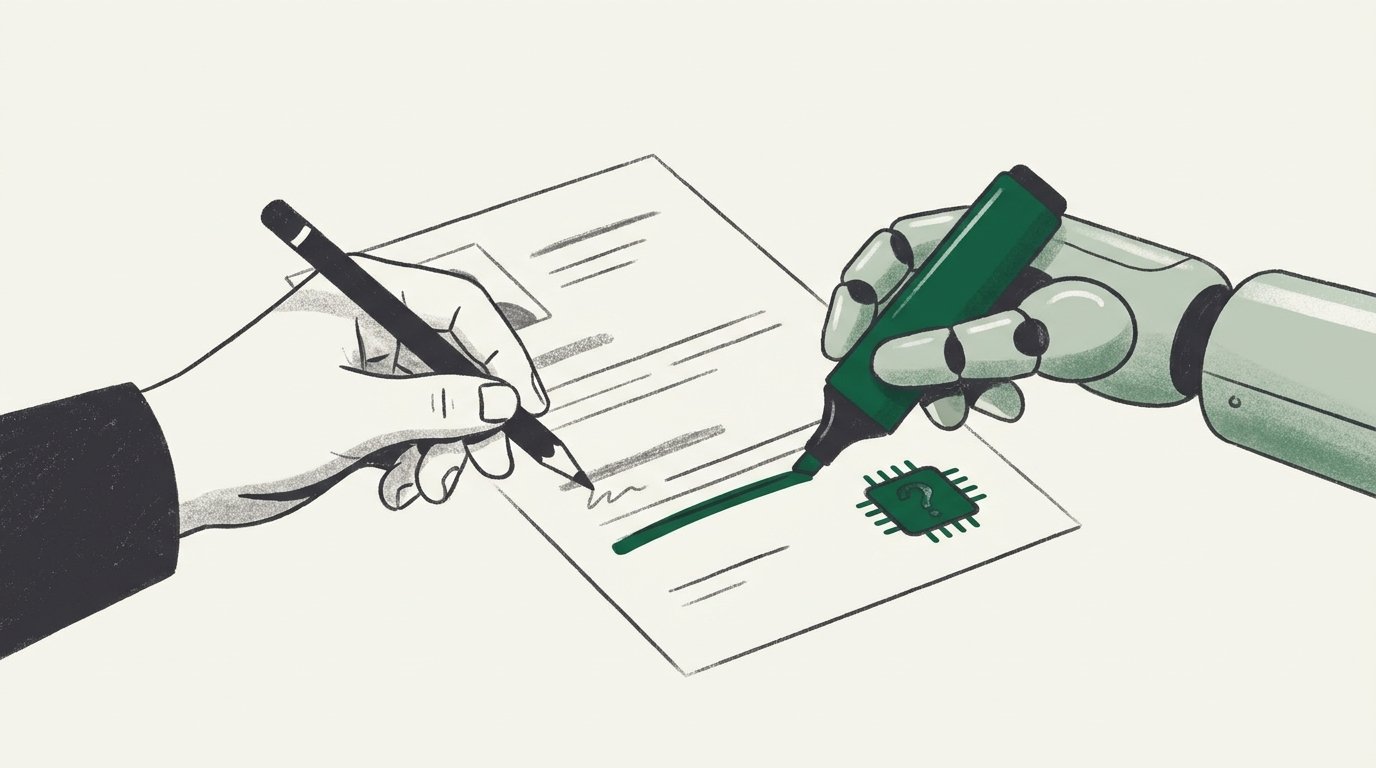
Interview skill is a rehearsal problem. Almost nobody is naturally good at compressing years of work into structured two-minute answers under scrutiny; the people who seem naturally good have simply done more reps. The historical bottleneck was rep supply — friends get bored, coaches cost real money, and practicing into a mirror gives no feedback. This is exactly the bottleneck ai interview prep removes: a language model will play a skeptical hiring manager at midnight, for the fortieth repetition, with specific feedback every time and no social cost when you bomb an answer. Of everything AI does in a job search, this may be the highest ratio of genuine value to hype.
It also has real limits, and knowing them up front is what separates useful rehearsal from a false sense of readiness. That is where we will start.
What AI mock interviews can and can't simulate
What AI simulates well:
- The questions themselves — behavioral, situational, and role-specific questions of realistic quality, including plausible follow-ups that probe your first answer
- Structural feedback — whether your answer had a situation, an action, and a result, or wandered for three minutes without landing
- Relentlessness — a model never lets you off with "yeah, that was fine," if you tell it not to
- Volume and availability — rep forty is as cheap as rep one
What AI cannot simulate:
- Stakes. Your heart rate in a real interview is a physiological fact no chat window reproduces, and managing it is a skill that only partially transfers from calm practice.
- The human read. Real interviewers react to your energy, interrupt, get visibly bored or engaged; models are politely turn-based.
- Company-specific truth. A model can guess what a company might ask; it does not actually know this team's culture or this manager's pet question.
The practical conclusion: use AI for volume and structure, and if at all possible, keep one live mock with a human for pressure calibration. AI reps make the human rep count.
The mock interview prompt: role, posting, and pressure settings
The default failure of AI practice is a model that is too nice. This prompt fixes that. Paste your resume text and the job posting after it.
Run a mock interview with me. Setup:
- You are a hiring manager for the role in this posting. You are experienced, time-pressed, and skeptical by default. [paste posting]
- You have my resume. Ask about what is actually on it. [paste resume]
- One question at a time. Wait for my answer before continuing.
- Follow up when my answer is vague, unquantified, or dodges the question — as a real interviewer would. Do not move on until you have pushed at least once.
- Do not compliment my answers during the interview. Save all feedback for the end, when I say "debrief."
- Mix: 2 background questions, 4 behavioral, 2 role-specific technical or scenario questions, 1 curveball.
Two settings to adjust deliberately. Pressure: for a friendlier rehearsal early in prep, change "skeptical" to "neutral"; for final-round prep, add "interrupt me if I exceed two minutes." Format: for panel practice, tell it to alternate between two personas with different priorities — it handles this surprisingly well.
Answer out loud, not by typing, even in a text chat — speak your answer, then type a condensed version or use voice input. Typing lets you edit mid-thought, which is precisely the luxury interviews do not offer.
Feedback loops: getting graded on structure, filler, and evidence
The interview is half the value; the debrief is the other half. When you say "debrief," use this:
Grade each of my answers on: (1) structure — did it follow situation, action, result, or ramble; (2) evidence — specific facts and numbers vs generalities; (3) length — which answers exceeded two minutes of speech; (4) the question behind the question — where did I answer literally but miss what you were really probing. Then list the three answers most in need of rework, and re-ask me the worst one now.
That final instruction — re-ask the worst one immediately — is the highest-value sentence in the whole workflow. Feedback without an immediate retry mostly evaporates; feedback followed by a rep sticks.
For behavioral answers specifically, grade against the STAR method explicitly: ask the model to label which sentence of your answer was situation, task, action, and result. Answers with a missing R are the most common pattern it will find — and if your resume bullets were built with the STAR-compressed bullet technique, you already have the raw stories; practice is expanding them back out loud.
One honest note on truth: a model grades delivery, not accuracy. It cannot know whether your story actually happened the way you told it. The standard from the rest of this cluster applies unchanged — rehearse true stories well, and never let good phrasing upgrade what actually happened.
Predicting your interview questions from the job posting
Interviewers write questions from the same document you applied to. That makes question prediction one of the most reliable AI prep tasks:
From this job posting, predict the 12 most likely interview questions. For each: which posting phrase it comes from, and what a strong answer must include. Categorize: screening, behavioral, technical, motivation. [paste posting]
Cross-check the output against a standard list of common interview questions — the union of "always asked" and "predicted from this posting" is your prep syllabus. Then close the loop with your own resume:
Now read my resume as this same hiring manager. Which three items would you probe hardest — gaps, short stints, big claims — and what exactly would you ask? [paste resume]
This surfaces the uncomfortable questions you are motivated to avoid rehearsing, which are the ones that most need reps. A resume claim you cannot expand on fluently for two minutes is either under-rehearsed or overwritten; both are fixable before the real conversation, and the same audit logic applies as in keeping AI-drafted resumes defensible.
Voice practice vs text practice: when each helps
They train different muscles, and a full prep uses both.
Text practice is best early: refining what your answers contain, iterating on story selection, tightening structure. Editing is a feature at this stage — you are writing the material.
Voice practice is where the material becomes performable. Speaking surfaces everything text hides: filler words, sentences that are grammatical on screen and unsayable aloud, answers that read as ninety seconds and speak as four minutes. Most major AI chat apps now support voice conversations, which makes spoken mock interviews free; dedicated prep tools add polish like pacing metrics and filler-word counts. If you have neither, the fallback is old and effective — record your spoken answers on your phone and listen back once. Painful, and worth it.
Sequence matters: text to build, voice to rehearse, never voice-only (you will polish weak content) and never text-only (you will freeze rendering good content aloud).
Dedicated AI prep tools vs a chat window: honest comparison
Dedicated interview-prep products offer packaged versions of everything above: question banks per role, voice interfaces, structured scoring, sometimes video with delivery analysis. Are they worth it over a well-prompted chat window?
An honest sorting. The chat window, with the prompts in this article, covers question generation, mock interviews, follow-up pressure, and structural debriefs — the core value — at zero cost. Dedicated tools genuinely add convenience (no prompt setup), consistency of scoring across sessions, and in some cases delivery analytics a chat cannot do. They do not add fundamentally better questions; the underlying models are similar.
Our suggested rule, consistent with the wider AI job-search tool sorting: start with the free chat workflow. Pay for a dedicated tool only if a specific gap — usually voice analytics or the discipline of a structured program — is demonstrably what is holding you back. Beware any tool marketing "real-time AI answers during your actual interview": that is a different product, it crosses the line from preparation into deception, and some employers explicitly prohibit it.
The prep schedule: three AI sessions before the real thing
A minimal, realistic structure for the week before an interview:
Session 1 (60 minutes, several days out) — mapping. Run question prediction and the resume-probe prompt. Choose your six core stories to cover the predicted behavioral ground. Draft answers in text; debrief on structure and evidence.
Session 2 (45 minutes, two days out) — full mock, voice. Complete mock interview with the skeptical persona, spoken answers, full debrief, immediate retry of the two weakest answers.
Session 3 (30 minutes, the day before) — targeted repair. Not another full mock. Re-run only the answers that failed session 2, plus one pass on the awkward questions (gaps, departures, the claim you always fumble). End on a rep you are proud of; confidence compounds overnight.
Slot these into the broader logistics — research, questions to ask them, and day-of mechanics — covered in the complete interview preparation guide.
Frequently asked questions
Can AI predict the actual questions I'll be asked?
It predicts categories and posting-derived questions well — often uncannily so for behavioral and screening rounds — but it is inferring from the posting, not reading the interviewer's mind. Treat predictions as a syllabus, not a script, and prepare stories flexible enough to serve many questions.
Is practicing with AI better than practicing with a person?
It is better for volume, availability, and shameless repetition; a person is better for pressure realism and reading delivery. The strongest prep uses AI for the first forty reps and a human for the dress rehearsal. If you can only have one, take the reps.
Will AI-rehearsed answers sound robotic in the real interview?
Over-rehearsed answers sound robotic however you rehearsed them. Practice stories and structures, not scripts — rehearse the same story in different words across reps, which builds flexibility instead of recitation. The debrief prompt's length grading helps here too.
Is it cheating to use AI during the actual interview?
Live AI assistance in an interview misrepresents your unaided ability, violates many employers' stated policies, and is obvious more often than users think. Preparation before the interview is what every strong candidate has always done; the line sits exactly at the moment the conversation becomes real.
Walk in with the reps already done
Interviews interrogate your resume, so make sure the document sets up questions you want. Workplacea's free resume checker shows what your resume signals before an interviewer ever reads it, and the editor keeps every AI-assisted line defensible — visible diffs, no invented claims — so nothing on the page can ambush you in the room.