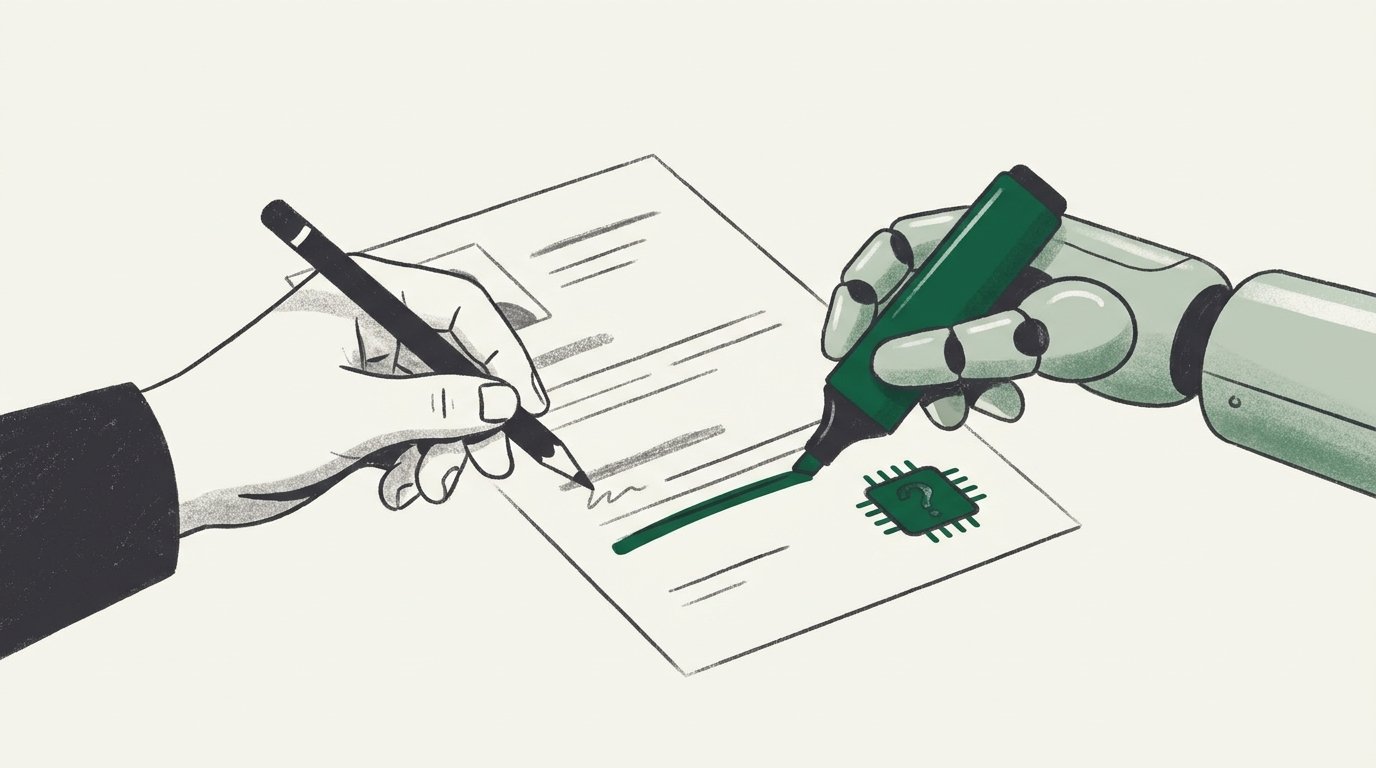
Somewhere between drafting your third tailored resume of the week and watching a chatbot phrase your career better than you ever have, the doubt arrives: is using AI for your resume cheating? It is a fair question, and it deserves better than the two lazy answers it usually gets — the vendor's breezy "of course not, everyone does it" and the purist's "real candidates write their own materials." Both dodge the actual ethical content of the question. We build an AI resume tool, so we have an obvious interest here; we will state our position plainly at the end and try to earn it with the reasoning in between.
The question behind the question: what would you be hiding?
"Cheating" implies a rule being broken and an advantage gained by deception. So start by asking what, exactly, would be concealed if you used AI and did not mention it.
A resume has never been a writing exam. No employer has ever believed that every candidate personally crafted each phrase unassisted — career coaches, professional resume writers, sharp-eyed friends, university career centers, and books of sample bullets have shaped resumes for generations, all without disclosure and without scandal. The document's implicit contract was never "I wrote this alone." It has always been "the facts in this document are true, and I stand behind them."
That reframing does most of the work. If AI helped you state true facts clearly, nothing in the contract is broken. If AI supplied facts that are not true, the contract is broken — and it would be equally broken if you had typed the lies yourself. The tool never appears in the contract at all.
The line: polishing true claims vs generating false ones
Here is the boundary as concretely as we can draw it.
On the honest side of the line:
- Rewriting your rambling description of a project into a tight bullet
- Suggesting stronger verbs for things you genuinely did
- Reordering and trimming content to fit a posting's priorities
- Mirroring a job description's terminology for skills you actually have
- Asking AI to interrogate you for forgotten achievements ("what questions would surface my impact in this role?")
Over the line:
- Accepting metrics AI invented because they sounded plausible
- Keeping skills or tools on the resume that AI added and you have never used
- Letting "helped with" become "led" because the generated version read better
- Generating an entire work history section from a job title and light editing it into your name
The pattern is visible immediately: every honest item starts from your facts, and every dishonest item ends with claims that are not yours. The tool is constant across both lists; the truthfulness of the output is the only variable. This is why our entire recommended AI workflow is built around evidence in, audit after — and why the most damaging AI resume mistakes are all, at root, truthfulness failures rather than style failures.
One nuance worth honoring: the line can be crossed passively. You did not ask AI to lie; it added a plausible number, and you were tired, and you kept it. Ethically, keeping it is the act. Fatigue-plus-fluency is exactly how honest people end up with dishonest resumes, which is an argument for workflows where every AI change is visible rather than blended invisibly into your text.
What employers actually say
We would love to hand you a definitive statistic here. We will not, because the survey landscape is noisy: different surveys of employers and recruiters, run with different questions and samples, have produced a wide spread of results, and this space moves fast enough that any specific number would be stale or cherry-picked. What we can report honestly is the direction of the pattern across published surveys and our own conversations with recruiters:
- Acceptance of AI as a drafting and editing aid is broad and growing; many recruiters describe candidate AI use as assumed rather than notable.
- Objection concentrates almost entirely on outcomes, not tools — fabricated experience, inflated titles, and interview performance that contradicts the page.
- Formal company policies about candidate AI use remain rare; where expectations exist (some employers ask that assessment exercises be done unaided), they are stated explicitly in the process.
That last point gives you a workable rule: where an employer explicitly sets a rule — "complete this writing sample without AI assistance" — the rule defines cheating, and breaking it is cheating regardless of your private ethics. Absent a stated rule, the truthfulness standard governs. Recruiters' actual, observed screening priorities support this; they are covered in detail in what recruiters told us about AI on resumes.
The hypocrisy angle: companies use AI to screen you
Any ethics discussion here has to acknowledge the asymmetry. The hiring side of the table adopted automation first and most aggressively: applicant tracking systems parse and rank your resume, AI tools help source and screen candidates, chatbots conduct pre-screens, and plenty of job postings were themselves drafted by a model. A candidate hand-writing every application while being evaluated by software is not occupying higher moral ground; they are bringing a quill to a keyboard fight.
This argument has real force, but be careful what it licenses. The asymmetry justifies using AI for efficiency and polish — matching the tooling level of the process you are in. It does not justify lying, because the wrong in a fabricated credential was never about effort or tooling; it is that someone may hire you to do things you cannot do. Two sides automating does not suspend the truth requirement for either.
Edge cases: where honest people get it wrong
The plausible metric. AI writes "improved response time by 35%." You did improve response time; you never measured it. Keeping the number is fabrication, even though the direction is true. The honest fix: replace it with what you can defend — "cut typical response time from about two days to same-day" — using the estimation discipline from quantifying achievements honestly.
The adjacent skill. AI lists a tool that people with your title usually know. You do not know it. Delete it. "I could learn it quickly" is an interview sentence, not a resume claim.
The upgraded verb. "Participated in migration" became "led migration." If you led it, keep it proudly. If you did not, this is the inflation most likely to detonate in an interview, where the actual leader may be one reference call away.
The tailored persona. After aggressive AI tailoring for six different postings, your six resumes describe six people. Tailoring emphasis is honest; tailoring identity is not. Every version should be a true subset of the same career.
Disclosure: when anyone actually expects it
The practical answer: almost never. No convention exists for disclosing drafting assistance on resumes or cover letters, just as none existed for professional resume writers, and volunteering "AI helped write this" in an application mostly communicates anxiety. The exceptions are explicit: an employer instruction that an exercise be completed without AI, or a direct interview question, which you answer truthfully and without drama — "I used AI tools to help edit and structure it; the content is mine." If saying that sentence would embarrass you, the problem to fix is in the content, not the disclosure.
Our stance, stated plainly
We build an AI resume tool, so discount accordingly — but our position is the one implied everywhere above. Using AI on your resume is not cheating; putting untrue things on your resume is, with any tool or none. We built Workplacea's product mechanics around that exact line: the AI proposes, you see every change as a redline diff, nothing applies without your approval, and when a claim would be stronger with a number you have not provided, the editor asks you for it instead of inventing one. An AI resume tool that quietly writes fiction is not helping you cheat, exactly — it is cheating you, because you are the one who has to survive the interview.
Frequently asked questions
Is it cheating to use AI for a cover letter too?
Same standard, higher stakes on voice: a cover letter claims to express your genuine interest, so the angle and the story must be real even though the drafting help does not need disclosing. A letter grounded in a true story and an honest reason for applying is yours no matter what phrased it.
What if a job posting says they value "authentic, personally written applications"?
Aspirational language in a posting is not a rule, but it tells you the reader's taste — lean your effort toward voice and specificity. If an application explicitly instructs you not to use AI on some component, follow the instruction; a stated rule defines the game.
Can I list AI tools as a skill if I used them to write the resume?
Using a chatbot to draft bullets does not make "AI proficiency" a professional skill, any more than using spellcheck makes you an editor. List AI tools when you have used them for actual work output in ways you can discuss concretely.
Where is the line on AI-assisted interview prep?
Rehearsing answers about true experience with an AI interviewer is preparation, fully legitimate. Having AI feed you answers live during an interview is deception in most contexts and explicitly prohibited in many. The distinction is the same as the resume one: help getting better at telling the truth versus help performing something false.
Keep every claim yours
If you want AI assistance that structurally cannot cross the line for you, that is the product we tried to build: visible diffs, grounding guardrails, and prompts for real numbers instead of invented ones. Start with the free resume checker to see where your resume stands, or take the editor for a run on the free plan.