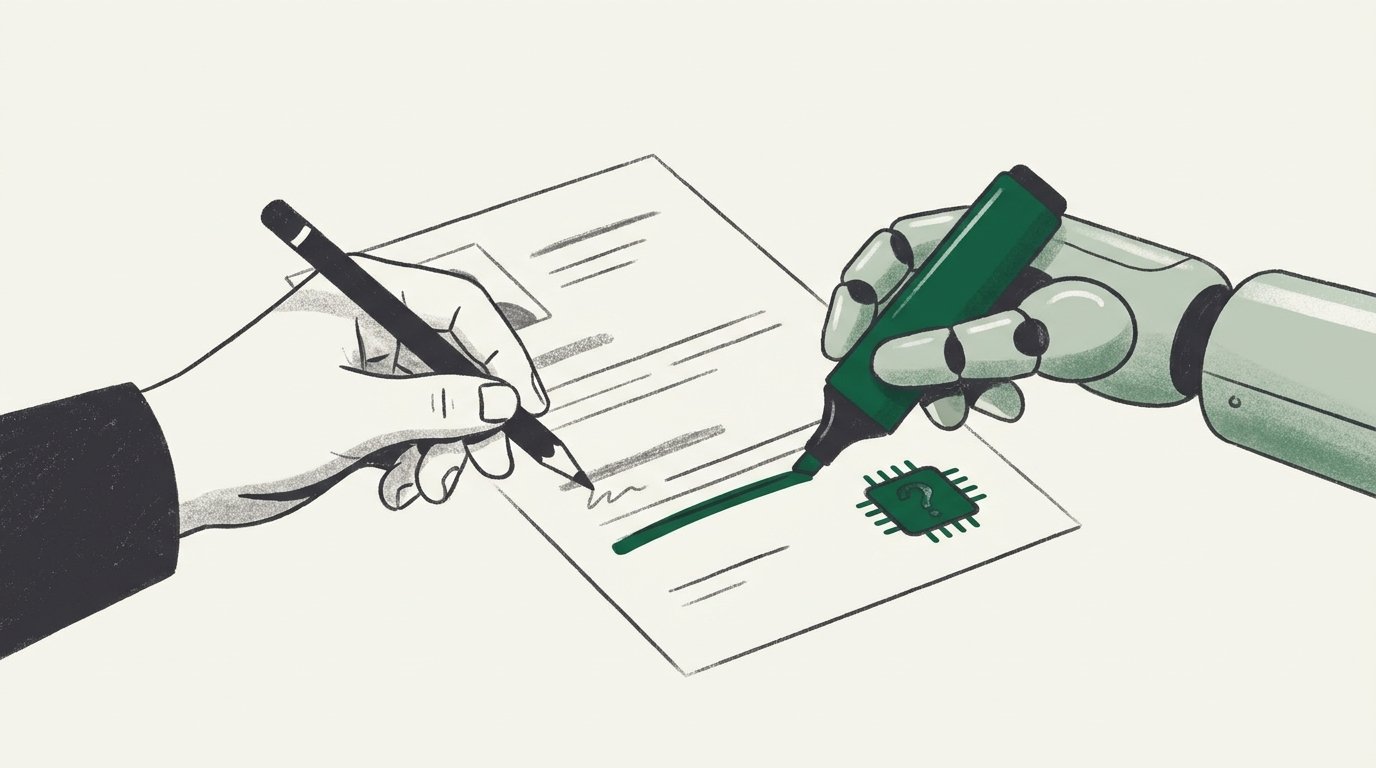
Can recruiters tell if you used AI on your resume? It is one of the most searched anxieties of the current job market, and the honest answer has a shape most articles avoid: no, not reliably — and it is also the wrong question. What recruiters can tell, instantly and with high confidence, is when a resume is generic. Unedited AI output happens to be generic in a very recognizable way. The distinction matters because it changes what you should actually do about it: not hide the tool, but fix the sameness.
We have talked with recruiters and hiring managers about this regularly — informally, at the scale of a company that builds resume software, not as a formal study, so treat what follows as reported practitioner experience rather than survey data. Their answers were remarkably consistent.
The short answer: they spot generic, not AI specifically
No recruiter we have spoken with claims they can look at a well-edited document and know a model touched it. What they describe instead is a gut reaction to a cluster of qualities that unedited generation produces at scale: text that is fluent, confident, structurally perfect, and says nothing specific about a human being.
One framing that stuck with us: "I can't tell you if a resume used AI. I can tell you in about ten seconds whether anyone — the candidate or a machine — actually knew this person's work." That is the real screen. A resume written by hand from vague memory fails it. A resume drafted by AI from rich, true input passes it. The tool is not the variable; the input and the editing are.
This should reframe your worry. The risk of using AI is not detection. The risk is submitting the average of everyone else's resume with your name at the top.
The tells recruiters actually report
When we asked what triggers the "this is generated" feeling, the same tells came up repeatedly:
Phrase clustering. Certain words now arrive in flocks: "spearheaded," "leveraged," "meticulous," "dynamic," "fostered," "seamlessly orchestrated cross-functional initiatives." Any one is fine. Six in one document, all polished and none concrete, reads as generation — or at minimum as writing nobody thought about.
Uniform structure. Ten bullets of nearly identical length and identical rhythm — verb, task, comma, outcome clause — produce a visual monotony human writing rarely has. People are messier than models, and the mess reads as authenticity.
Confident vagueness. Bullets that sound impressive and withstand no questions: "Drove significant improvements in operational efficiency across key workstreams." Improvements in what, measured how? Recruiters call this the sentence that dissolves when you poke it.
Resume-to-human mismatch. The strongest tell arrives later: flawless prose on the page, then a phone screen where the candidate cannot speak fluently about their own bullets. Several recruiters said this is the only moment they actually conclude "AI wrote this and the candidate didn't read it."
Wrong-register jargon. Enterprise vocabulary on an entry-level retail resume; another field's terminology imported because the model pattern-matched the job title. This overlaps heavily with the ten AI resume mistakes that give people away.
Notice what is absent from the list: em dashes, specific formatting, any single mechanical marker. Recruiters read for substance, and the tells are all substance-level.
AI detectors: why they don't work and who uses them anyway
Automated AI-text detectors exist, and some organizations experiment with them. You should know three things.
First, detection of AI-generated text is unreliable in general, and resumes are close to a worst case for it: short documents, rigid conventional structure, and formulaic phrasing that was standard on human-written resumes decades before language models existed. Tools in this category produce both false positives and false negatives, and vendors' own disclaimers generally say not to use them for high-stakes decisions.
Second, practices vary and are mostly informal. Some recruiters paste suspicious cover letters into a detector out of curiosity; systematic screening of resumes for AI use is not standard practice in any hiring stack we are aware of. We will not quote adoption numbers because we have not seen trustworthy ones.
Third, even where a detector is used, what typically triggers scrutiny is the same generic quality a human would flag anyway. The defense against both the human and the machine reader is identical: specific, true, personally voiced content. That is worth internalizing — there is no cat-and-mouse game to win here, just a quality bar.
The interview risk: when your resume writes checks you can't cash
Every recruiter we asked located the real danger downstream of the screen. A generated resume that inflates scope or invents fluency gets some candidates more interviews — and then destroys them there.
The pattern is consistent: the interviewer asks a routine follow-up on a bullet ("walk me through how you cut processing time 40%") and the candidate visibly meets the claim for the first time. Recovery from that moment is rare, because it converts one weak answer into doubt about every line of the document. Interviewers do not conclude "AI wrote this"; they conclude "this person is not who the paper says," which is worse.
This is why the truth pass in our AI writing workflow is non-negotiable: every claim on the page must be one you can expand on for two unrehearsed minutes. If a bullet is true but you have not thought about it since AI phrased it, rehearse it — the claim being technically accurate does not help if you stumble presenting it.
A simple pre-interview exercise closes the gap: go through your resume line by line and, for each bullet, say aloud one concrete detail that is not on the page — the tool involved, the obstacle, the person you worked with, how you knew it worked. If a bullet yields nothing beyond its own wording, it either needs rewriting toward something you genuinely know deeply, or it needs to come off the resume before it becomes a liability in the room.
What recruiters say they care about (relevance beats provenance)
Asked directly whether AI use bothers them, most recruiters shrugged. Their screening reality is volume: large applicant pools, minutes or less per resume, a mandate to find people who can do the job. Within that reality, they consistently ranked what matters:
- Relevance — does the experience match what the role needs
- Evidence — specific outcomes, honest numbers, concrete scope
- Clarity — can the above be absorbed in a fast read
- Provenance — essentially nowhere
Several pointed out the obvious asymmetry: their side of the table uses AI throughout the hiring stack — sourcing, screening support, scheduling, sometimes drafting the job posting itself. Objecting to candidates using drafting help would be, in one recruiter's words, "a strange hill." The ethics question has real content, but it is about truthfulness rather than tooling — we take that question up fully in whether using AI for your resume is cheating.
The safe standard: every claim true, every word one you'd say aloud
Collapsing all of this into a rule you can apply in five minutes:
- The truth test. Could you defend every number, verb, and scope claim to a skeptical interviewer who knows the field? If not, the problem is the claim, not the AI.
- The read-aloud test. Read the resume out loud. Every phrase you would never say in conversation — every "leveraged synergies to drive impactful outcomes" — gets rewritten in your own words. This single edit removes most of what recruiters describe as the AI feel; the full voice pass method systematizes it.
- The stranger test. Could any competent person in your field claim this exact bullet? If yes, it is missing the specifics that make it yours.
Pass all three and the detection question stops mattering, because there is nothing to detect except a well-written, true document.
Frequently asked questions
Do ATS systems flag AI-written resumes?
Applicant tracking systems parse, store, and search resumes; screening for AI authorship is not what they are built to do, and we are not aware of mainstream ATS platforms rejecting resumes on that basis. The parsing concerns that actually matter are formatting-related and apply equally to human-written documents.
Will I be rejected if a recruiter suspects AI?
For suspicion alone, rarely — most recruiters told us they assume widespread AI use already. What earns rejection is what suspicion usually accompanies: generic content that gives them no reason to advance you, or claims that wobble under a first question.
Are AI detection tools ever used on resumes?
Occasionally and informally, more often on cover letters than resumes. No detector is reliable on documents this short and formulaic, and practices vary too much across companies to plan around. Write for the human reader; the machine question takes care of itself.
Is it safer to just not use AI at all?
Not using AI does not protect you from the actual filter, which is genericness — plenty of purely human-written resumes are vague and clichéd. Used with real input and a truth pass, AI typically makes resumes more specific, not less. The tool is neutral; the workflow decides the outcome.
Make the question irrelevant
Workplacea's editor is designed so there is never a claim on your resume you did not personally approve: every AI edit shows as a redline diff, and missing numbers get asked for, never invented. Check what your current resume signals with the free resume checker, or open the editor and see the diff-first workflow on your own bullets.