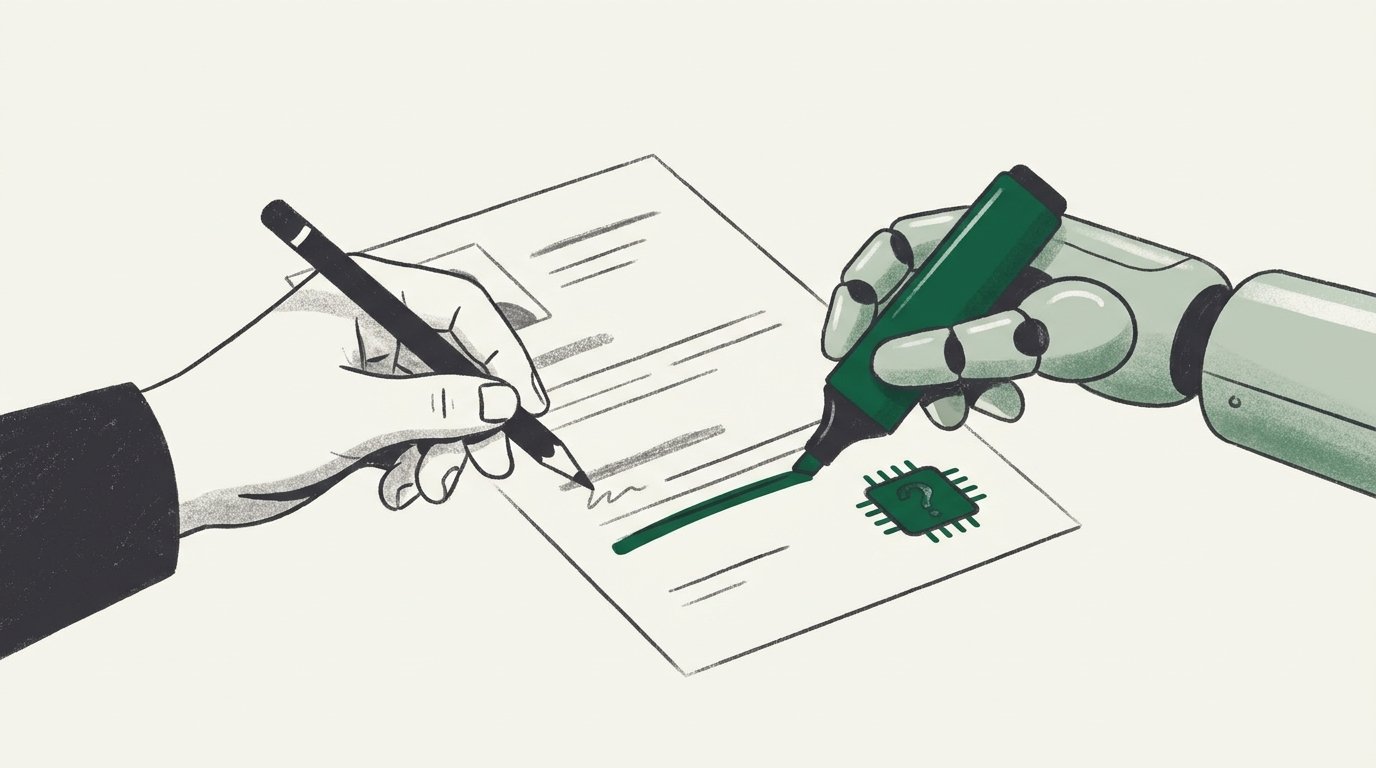
You accepted the AI's rewrite because it was objectively better — tighter, more professional, better verbs. Then you read the whole page and felt the strange flatness: every claim is yours, every fact survived the audit, and somehow the document describes a stranger. Learning to make an AI resume sound like you is the last, most-skipped step of AI-assisted writing, and it matters more than people think. Recruiters cannot reliably detect AI, but they respond — consciously or not — to voice, and a voiceless resume reads like a voiceless candidate. The fix is not mystical and does not require re-writing from scratch. It is a 20-minute editing pass with specific, mechanical steps.
This assumes your content is already true and audited; if you have not done the truth pass, do that first — the full AI writing workflow covers it. Voice-polishing fabricated content just produces well-voiced fiction.
Why generated text has a tone — and why recruiters feel it
Language models write by predicting the most likely next word, and the most likely word is, by definition, the most average one. Trained on oceans of professional text, a model's default register is the mean of all professional writing: fluent, balanced, slightly formal, allergic to risk. It prefers the common phrase to the specific one, the smooth rhythm to the varied one, the safe claim to the vivid one. Every individual sentence is fine. The aggregate is text with the texture of oatmeal.
Human writing, even mediocre human writing, is idiosyncratic. You have pet words. Your sentences vary because your thoughts do. You mention the odd, specific detail because it mattered to you. Readers register these signals below the level of attention — which is exactly why recruiters describe a feeling ("this reads generated") rather than pointing to a rule. What they are feeling is the absence of a person. As recruiters themselves report, they cannot prove provenance and mostly do not care about it; they respond to genericness. Voice is the anti-generic.
The read-aloud test: the fastest AI-tone detector
Before any technique, run the diagnostic. Read your resume out loud — actually aloud, at conversational speed, preferably standing somewhere nobody can hear you.
Your ear will catch what your eye rubber-stamps. Mark every line where one of these happens:
- You stumble or run out of breath mid-bullet — the sentence has generated-text structure, stacked clauses no speaker would attempt
- You would never say this phrase to a colleague — "leveraged cross-functional synergies" does not survive being spoken by a human face
- You feel faint embarrassment — the register is inflated beyond how you talk about your own work
- You lose interest in your own sentence — if the author is bored aloud, the reader was bored silently
The marked lines are your worklist. In a typical AI-assisted resume, expect five to twelve marks. Everything below is how to fix them.
Phrase swaps: AI's favorite words and your replacements
Generated resumes over-concentrate a particular vocabulary. None of these words is wrong alone; in clusters, they flatten voice. Sweep for them:
| AI's pick | Say instead |
|---|---|
| spearheaded | started, ran, proposed and led |
| leveraged | used |
| utilized | used |
| facilitated | ran, organized, helped X do Y |
| seamlessly | (delete) |
| dynamic, fast-paced | (delete, or name the actual pace: "40 releases a year") |
| results-driven, detail-oriented | (delete — show a result, show a detail) |
| cross-functional collaboration | worked with sales and engineering (name the actual functions) |
| stakeholders | the people in question: clients, executives, the ops team |
| robust, scalable, impactful | the concrete property you mean |
The pattern behind the table: prefer the word you would say, name the specific thing instead of the category, and delete intensifiers that carry no information. This overlaps heavily with the general buzzword purge — AI did not invent corporate filler, it just deploys it at industrial density.
One caution in the other direction: do not swap into false casualness. "Wrangled the budget" is not more authentic than "managed the budget" if you would never say "wrangled." The target is your register, not a folksy costume.
Rhythm breaks: varying bullet structure on purpose
Read six generated bullets in a row and you can conduct them: verb, object, clause, outcome — eighteen words — verb, object, clause, outcome — eighteen words. Uniform rhythm is one of the strongest generated-text signals, and it is invisible bullet-by-bullet, which is why you fix it at the page level.
Concrete moves, applied across each role's bullet group:
- Cut one bullet brutally short. "Shipped the migration two weeks early." Six words land harder surrounded by twenty-word neighbors.
- Lead one with the result. "Same-day response time, down from two days — after rebuilding the ticket triage flow." Outcome-first breaks the verb-first monotony.
- Let one breathe. If a story needs twenty-five words, give it twenty-five; artificial compression to match its neighbors is the same uniformity in reverse.
- Vary the openers. If four bullets start with "Led," you did not lead four things identically — one was rescuing, one was building, one was convincing. Say those.
The test of success is visual as much as auditory: at arm's length, the bullet block should look slightly irregular, like something written by a person making choices.
Re-injecting specifics only you know: names, numbers, context
Here is the deepest fix, and the one no model can do for you. Generated text is generic because the model does not know the specifics — so the voice pass's core move is putting them back. For each major bullet, ask: what do I know about this that no one else could write?
- The named thing. "Migrated the CRM" is anyone's bullet. "Migrated 40,000 customer records from a nine-year-old Access database" happened to you specifically.
- The constraint. "Delivered the project on time" versus "delivered on time despite losing two of five engineers mid-project." The obstacle is the story.
- The honest number. Real figures — including honest ranges and "about" — are inherently voiced, because they are yours. If quantifying is the gap, the honest numbers method fills it without inventing anything.
- The odd detail. The 6 a.m. cutover window, the client in three time zones, the fact that it was your proposal in the first place. One per role is seasoning enough.
Specificity does double duty: it restores voice and it is also the strongest defense against reading as generated, since genericness is the actual tell recruiters react to. A resume dense with verifiable particulars cannot read like everyone else's, because it is not.
The 20-minute voice pass, step by step
The full procedure, assembled:
- Minutes 0–4 — read aloud and mark. Conversational speed, mark every stumble, cringe, and phrase you would never say. Do not fix anything yet.
- Minutes 4–9 — phrase sweep. Run the swap table over the whole document. Delete empty intensifiers on sight.
- Minutes 9–14 — rhythm pass. Per role: shorten one bullet hard, restructure one, vary repeated openers. Check the page at arm's length.
- Minutes 14–18 — specificity injection. For each marked-but-still-flat bullet, add the named thing, the constraint, or the real number. If you cannot recall the specific, flag it to look up rather than approximating.
- Minutes 18–20 — final read-aloud. The pass is done when you can read the whole page aloud without a single wince. That is the entire acceptance criterion, and it is stricter than it sounds.
One warning: do not run this loop more than twice. Editing voice indefinitely regresses toward a new kind of sameness — your third-guess phrasing is rarely better than your first honest one.
Keeping your voice when AI rewrites: the redline advantage
The cheapest way to preserve voice is to never lose it wholesale in the first place. Voice dies in bulk replacement: you paste your text, AI returns a fully rewritten block, and accepting it means accepting a hundred silent word choices at once — the model's words, the model's rhythm, everywhere.
Change-by-change review inverts this. When every AI edit is visible as an individual diff, you accept the genuinely better verb, reject the "spearheaded," keep your own phrasing where it was already right, and the document stays substantially yours all the way through. This is the core design of Workplacea's editor — every suggestion is a redline against your original, applied only when you approve it — and it means the voice pass shrinks from a rescue operation to a touch-up. In a plain chat tool, you can approximate it by instructing the model to output old and new versions of each line and never a full rewrite; the prompt library has the exact wording.
Frequently asked questions
How do I know what my professional voice even is?
You already use it daily — in emails to colleagues you like, in how you describe your work to a friend in the field. Record yourself explaining your last big project for ninety seconds, transcribe it, and note the verbs and phrasings you naturally reach for. That transcript is your reference register.
Won't casual phrasing hurt me with formal companies?
The voice pass does not make text casual; it makes it yours. "Ran the quarter-end close for three entities" is perfectly formal and still human. What you are removing is inflation and filler, which no company culture actually rewards.
Should I run a "humanizer" tool on my AI-drafted resume?
No. Humanizer tools apply another layer of automated rewriting — statistical noise on top of statistical smoothness — and often degrade accuracy in the process. Voice is restored by the person who has the specifics, not by a second model that also does not know your life.
Does voice really matter on a document recruiters skim in seconds?
The skim is exactly why it matters. In a fast read, specificity and rhythm are what snag attention, and sameness is what lets the eye slide off. Voice is not decoration on a resume; it is the difference between being read and being scrolled past.
Keep the person in the resume
If you would rather protect your voice than reconstruct it, work where AI never rewrites you silently: Workplacea shows every suggested edit as a diff you approve word by word, in the editor. And for a cold reading of how your current resume comes across — parse, structure, and rubric score — the free resume checker takes two minutes and no account.